
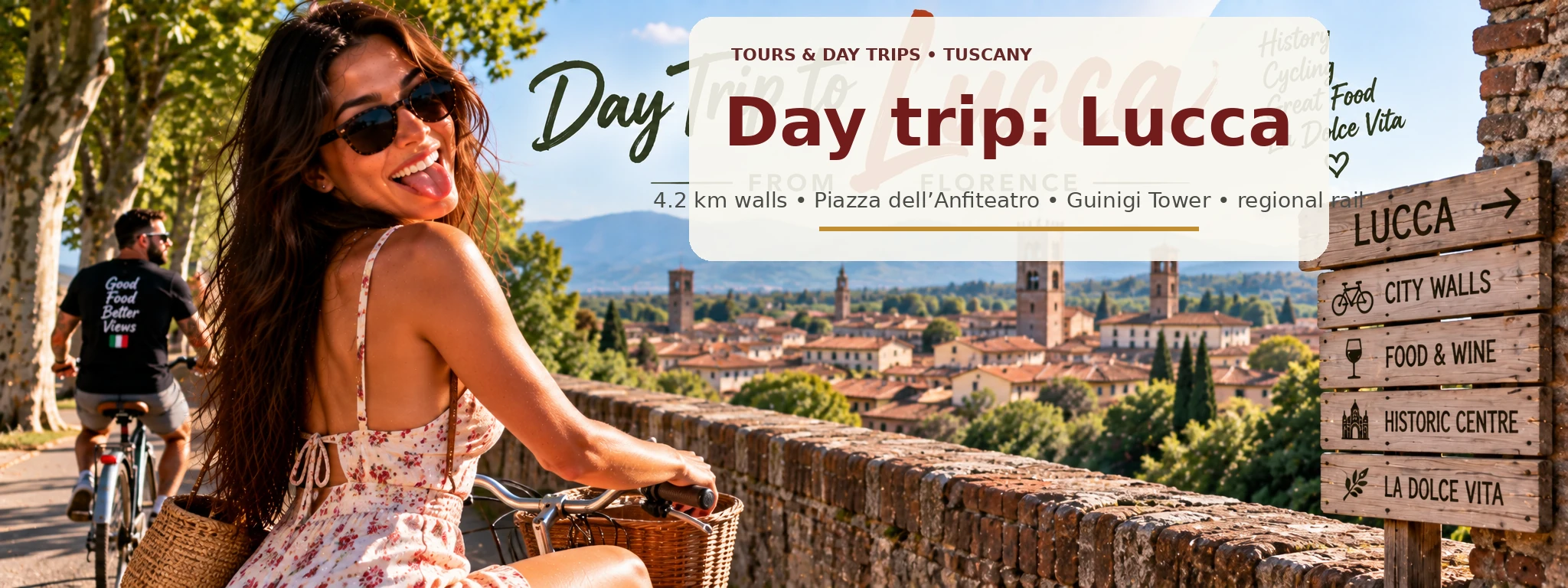
Lucca is the day trip I would choose when Florence has already given you enough queues and timed masterpieces. The city is rich in churches and towers, but its defining experience is unusually unhurried: get onto the walls, walk or cycle, drop into the historic centre, then decide which one or two paid sights deserve energy.
The intact walls run for about 4.2 kilometres around the centre. They were transformed into a public green space rather than demolished, so the city's fortification is now also its best promenade.
Getting there from Florence: use the live regional timetable
Trenitalia's Tuscany regional network currently includes Florence and Lucca in the same regional travel system, but individual journeys can be direct or involve a change depending on the departure. I would search the official timetable for your date instead of promising a fixed “direct 90-minute train”.
Lucca station sits just outside the walls, which is the logistical advantage once you arrive: you do not need a suburban transfer before the historic centre starts. Build a small return-time buffer because regional service patterns can vary through the day.
Walk one section of the walls before deciding whether to cycle all of them
The walls are broad, tree-lined and used as everyday public space. If cycling appeals, a full loop is a natural structure for the visit; if not, you lose very little by walking a section and dropping through a gate into the centre.
I would not turn the loop into a race. Bastions, views into the city and the contrast between rampart and street level are the experience.
Piazza dell'Anfiteatro is Roman geometry hiding in ordinary buildings
The oval Piazza dell'Anfiteatro follows the footprint of the Roman amphitheatre beneath and around it. Visit Tuscany notes that the original arena dates to the first or second century AD; buildings gradually occupied the ruined structure, and architect Lorenzo Nottolini cleared the central space in the nineteenth century to create the square you see now.
I would enter through one of the narrow gates, walk the curve and then leave again. It is more interesting when you read it as reused urban fabric rather than merely a photogenic café ring.
Guinigi Tower is the climb to book if you want one
The 45-metre Guinigi Tower is crowned by holm oaks and remains one of Lucca's signature sights. The official tourism office says the climb is 230 steps over 25 flights, with no lift. It is therefore not accessible to visitors with mobility disabilities.
Current guidance recommends reservations on weekdays and requires them on weekends and public holidays. Opening hours vary by month, so I would check Lucca Tourism's live tower page rather than hard-code one annual schedule.
Lucca Visit Card can make sense for a museum-heavy day
The current Lucca Visit Card bundles participating museums and attractions. At my September 2026 check, the 3-day Incanto option was €29 and the 10-day Wonder option €48, with conditions for minors and visitors with disabilities. For a single day trip, I would buy it only after counting the exact paid sights you actually intend to enter.
Do not skip the churches just because the walls are free
San Martino Cathedral, San Michele in Foro and San Frediano give Lucca much of its character. I would choose one church interior rather than sprint through all of them. The cathedral also anchors Lucca's Via Francigena/pilgrimage story, while San Michele's façade is one of the city's great street-level surprises.
How I would pace one day
Morning: arrive, walk a wall section and enter the centre before the busiest lunch period. Midday: Piazza dell'Anfiteatro, a church and lunch. Afternoon: Guinigi Tower if booked, then Via Fillungo and another wall section back towards the station.
If you prefer bikes, move the wall loop earlier and leave the tower optional. If mobility or stairs rule the tower out, the walls, squares and churches still make Lucca a strong day.
Lucca plus Pisa?
The two cities sit on the same wider regional rail network and can be combined, but I would only do it when your goal is breadth. If you already have a dedicated Pisa plan, give Lucca its own slower day. The entire point of choosing Lucca can disappear if you turn it into the afternoon half of a stopwatch itinerary.
Bike or walk? I would decide by the group, not the postcard
A bike makes the full wall circuit easy and fun, but walking gives you more freedom to drop into bastions, gates and streets whenever something looks interesting. Families with confident cyclists may love the loop; mixed-mobility groups or nervous riders lose nothing by walking a shorter section. The walls are the experience either way.
If you rent a bike, confirm return time and where riding is permitted before leaving the shop. I would not assume every pedestrian-heavy street in the historic centre is sensible simply because the wall itself is cycle-friendly.
Leave space for Lucca rather than collecting its landmarks
Lucca works because the historic centre still feels like a town people use, not a chain of attractions. I would plan one paid climb, one important church and the walls, then let Via Fillungo, coffee, a bakery or a second square fill the gaps. That is a better reason to come here than trying to reproduce a Florence-style masterpiece checklist on a smaller map.
Sources checked 6 September 2026: Lucca Tourism current city, Guinigi Tower and Visit Card information; Visit Tuscany walls, Piazza dell'Anfiteatro and city guidance; Trenitalia current Tuscany regional network information.
Cheers, Carpe Diem & let the walls set the pace! 🍻⏳🚲
TATS Man
Your slower-Tuscany-day itinerary editor.